This article may contain affiliate links. If you buy through them, guitar.care may earn a small commission at no extra cost to you.
Your Action Got Higher and Nobody Touched the Guitar
Action that creeps up in summer is almost always humidity, not a mechanical fault. Moisture swells the top, the bridge rises with it, and the strings follow. Confirm that with a hygrometer before you touch the truss rod — and if you're only slightly over spec, the right move may be waiting for fall.
The short answer
- Likely cause
- Room above 60% RH
- Target range
- 45-55% RH
- Acoustic action at 12th fret
- 7/64″ low E, 5/64″ high E
- Normal seasonal drift
- 1/64″ to 2/64″ over spec
- First tool to reach for
- Hygrometer, not a wrench
Here's what the wood is doing, how to confirm it, and when an adjustment is actually warranted.
Why Humidity Raises Action in Summer
Wood is hygroscopic — it absorbs moisture from humid air and releases it in dry air, and it changes shape slightly as it does. On an acoustic guitar, the top is thin, braced spruce or cedar that responds to moisture faster than the denser wood around it. As humidity climbs, the top absorbs moisture and swells, and because the bracing underneath resists expanding evenly, the top takes on more of a dome shape instead of staying flat. Taylor Guitars' symptom list for an over-humidified guitar leads with exactly the complaint that brings players here — strings sitting unusually high off the fretboard and getting harder to press down — alongside a dull, lifeless tone and a neck that sights low to the bridge.
That dome pushes the bridge upward, and since the strings run from the bridge over the saddle to the nut, raising the bridge raises the strings along their entire length — this is where summer's high action actually comes from. At the same time, the neck itself can absorb moisture and develop slightly more forward bow (relief), which adds even more string height on top of what the bridge is doing. Electric guitars are less affected because solid bodies don't have a thin top under string tension the way an acoustic does, but the neck wood still moves, so a Strat or Les Paul can pick up a small amount of extra relief and action too — just rarely enough to be dramatic.
Martin puts numbers on the tipping point. Its humidification bulletin calls 50% relative humidity optimum for preserving a wooden instrument, and at 60% or above it lists swelling of the top, high action, and loose braces and bridges among the typical symptoms. That's the gap you're closing when summer pushes a room past 60% — and why we target a 45-55% band throughout these guides rather than chasing a single number. Our humidity guide covers where that band comes from and how to measure it correctly if you want the fundamentals rather than just the summer symptom.
Confirm It's Humidity Before You Touch Anything
It's tempting to go straight for the truss rod wrench the moment action feels off, but adjusting a neck that's swollen from moisture is solving the wrong problem — you'll dial in a setting that becomes wrong again the moment humidity drops. Rule out humidity first.
Top pick
Digital Hygrometer
Monitors humidity where your guitar lives. The single cheapest insurance against cracks and warping.
Check the humidity where the guitar actually lives, not the regional forecast. A small hygrometer left in the case or the room tells you immediately whether you're dealing with a 65-70% environment (the likely culprit) or something else entirely. If the reading is comfortably inside 45-55%, humidity probably isn't your issue and the higher action has a different cause — strings well past their useful life, a setup that was already due, or a genuine mechanical shift worth a tech's attention.
Beyond the hygrometer, look for the other symptoms that travel with a humidity-swollen top: a soundboard that looks slightly domed rather than flat when you sight down it from the side, a string buzz that changes if you press on the top near the bridge, or tuning that won't hold as well as it used to even right after tuning up. Any of those alongside a high humidity reading points squarely at moisture, not a mechanical fault.
How High Is "Too High"? Measuring the Actual Problem
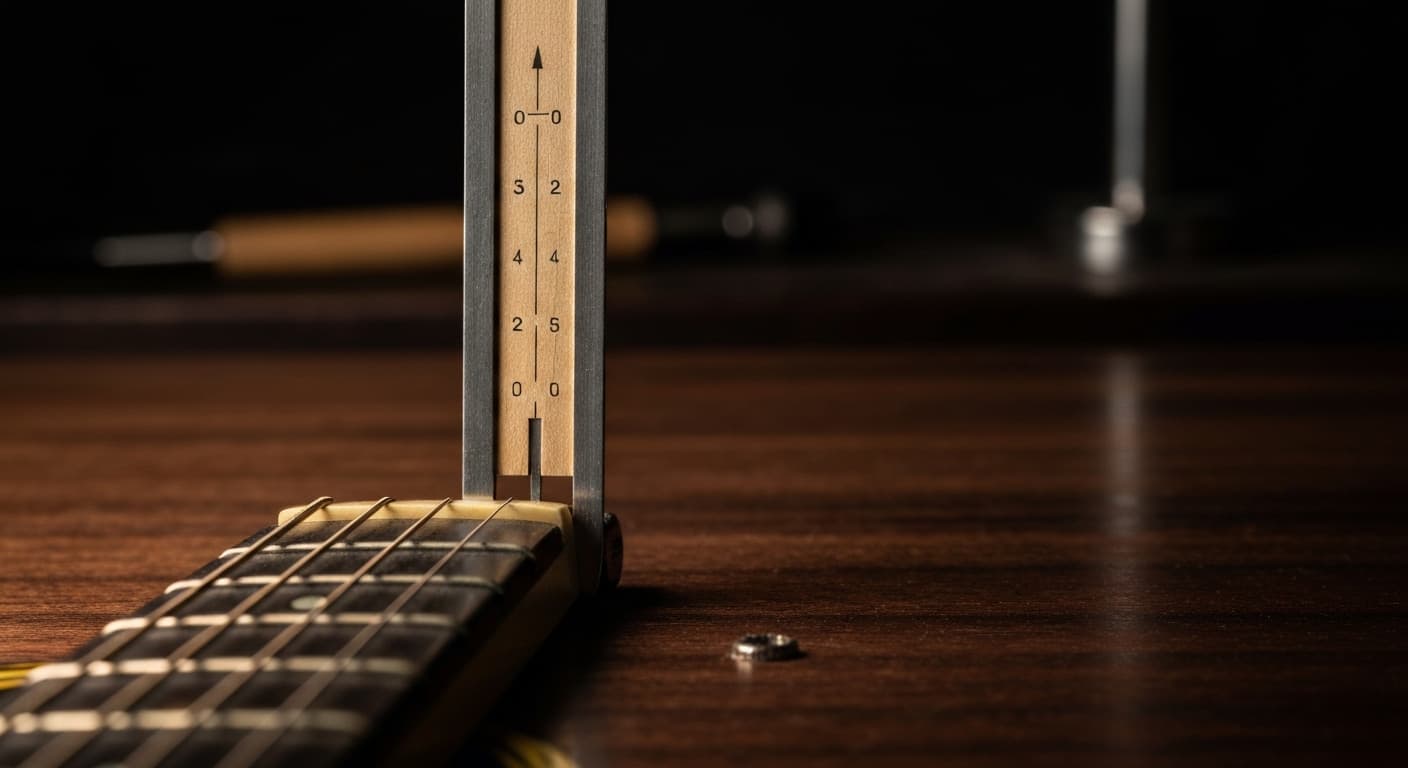
Before adjusting anything, measure where you actually are. At the 12th fret, a typical acoustic sits around 7/64" (2.8mm) on the low E and 5/64" (2.0mm) on the high E; electrics run lower, closer to 4/64" (1.6mm) and 3/64" (1.2mm). Our full setup guide has the complete measurement and adjustment walkthrough if you haven't done this before — it's worth reading in full rather than guessing at the numbers here.
If you're 1/64" to 2/64" above spec and the guitar is otherwise stable, that's a normal seasonal shift and often not worth a full readjustment — especially if you know fall will bring it partway back down on its own. If you're significantly higher, buzzing has been replaced by strings that feel like cables, or the neck relief measured at the 7th-8th fret is well outside the 0.008"-0.012" range for acoustics, it's worth an actual adjustment rather than waiting it out.
Fixing It: Three Options, in Order of How Much You Should Trust Them
1. Fix the Humidity First
If a hygrometer confirms the case or room is running high, get it back toward 45-55% before adjusting anything mechanical. A room dehumidifier helps if the whole space is humid; for the guitar specifically:
Recommended gear
In-Case Guitar Humidifier
Keeps a stable 45-55% humidity inside the case through dry winters and heated rooms.
An in-case two-way humidity control system buffers the guitar against whatever the room is doing, which matters most if you don't want to run a dehumidifier constantly. Give it a few days to a week after stabilizing humidity before you re-measure action — wood doesn't snap back to a new equilibrium instantly, and adjusting before it's settled means adjusting twice.
2. A Genuine Truss Rod or Saddle Adjustment
If the humidity is under control, you've given the wood time to settle, and the action is still meaningfully above spec, then a real adjustment is appropriate — this isn't a case you need to wait out.
Recommended gear
Guitar Setup Tool Kit
Feeler gauges, string action ruler, truss rod wrenches, and screwdrivers in one kit for DIY setups.
Small, incremental truss rod turns (an eighth to a quarter turn at most), rechecked after the neck settles for 10-15 minutes, are the safe way to bring relief back into range. If the truss rod is already close to correct and the action is still high, the fix is at the saddle — lowering it slightly on an acoustic, or adjusting bridge saddle height screws on an electric. Retune and recheck with a clip-on tuner after any adjustment, since changing string height and relief both shift pitch slightly.
3. Sometimes the Right Move Is Waiting
If you're a small amount over spec, humidity is genuinely seasonal rather than a year-round problem where you live, and the guitar isn't buzzing or unplayable, it's reasonable to leave it alone until fall. A neck and top that swell in July and August often partially relax back as humidity drops in September and October — dialing in a summer-specific truss rod setting means you're likely to be readjusting again in the other direction a few months later. Our seasonal care guide covers what to expect and check across all four seasons, which is useful context for deciding whether this round of adjustment is worth doing now or worth waiting on.
Preventing the Swing Next Year
The most effective fix is keeping the guitar's environment stable enough that summer action creep never gets bad in the first place. A hygrometer and, if needed, an in-case humidity system (both covered above) handle most of it. If you're deciding between a case built with humidity control in mind versus assembling your own setup, our breakdown of humidity-controlled guitar cases compares the built-in option against a standard hardshell case plus a separate humidifier and hygrometer, which is the cheaper route for a guitar that mostly stays home.
Storing the guitar in its case rather than on an open stand during the most humid weeks also helps, since a closed case is a much smaller volume of air to keep stable than an open room. For a broader routine that covers this alongside cleaning and setup maintenance year-round, our care guides walk through the full seasonal system rather than just the summer half of it.
What to Do Before You Reach for a Wrench
Higher action in summer is one of the most predictable seasonal guitar problems there is, and it's rarely a sign anything is actually wrong with the instrument — it's wood doing exactly what wood does when moisture in the air goes up. Confirm it with a hygrometer before you touch the truss rod, get the humidity back toward 45-55% if it's out of range, and only adjust the neck or saddle once you know you're correcting a real, settled change rather than chasing a swing that's about to reverse itself in the fall.